

The EIC Accelerator is one of the most selective and demanding public funding programmes in Europe. Run by the European Innovation Council, it is designed for deep-tech startups and scaleups developing breakthrough technologies with the potential to create new markets or fundamentally transform existing ones.
Unlike many innovation grants, the EIC Accelerator is not designed for incremental improvement or early experimentation. It targets companies that:
- are operating at the edge of technological feasibility,
- are tackling structurally complex or highly regulated markets,
- and require significant risk capital to reach market deployment.
The programme offers grant funding, equity investment, or blended finance, but funding is only one part of the story. What truly defines the EIC Accelerator is the evaluation process itself: a multi-stage examination of technology excellence, market impact, execution realism, risk awareness, and organisational maturity — all assessed at a European level.
This is the context in which we applied.
Why VendueTech applied
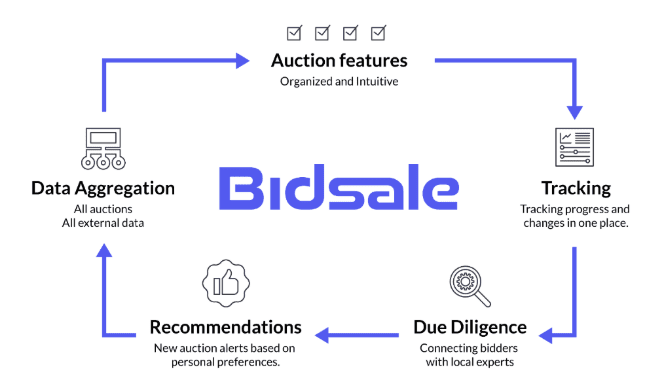
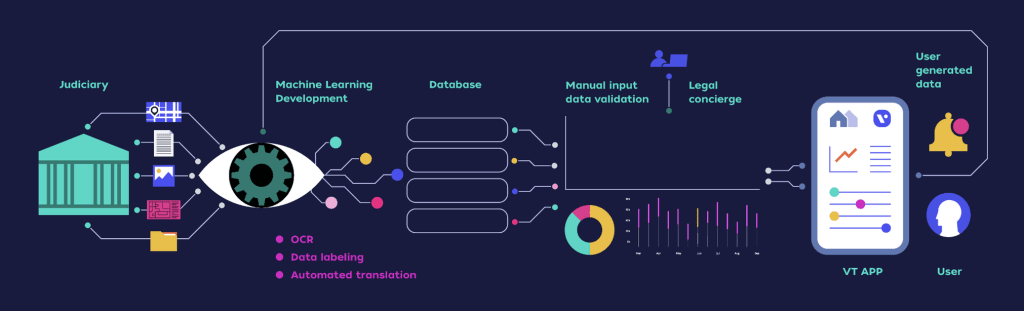
VendueTech is building Bidsale, an AI-driven platform that transforms fragmented public judicial and government auction data into actionable insights for professionals working with distressed real estate. The problem we are addressing sits at the intersection of deep technology, law, public data, and cross-border regulation — a space where innovation is urgently needed, but inherently difficult.
The EIC Accelerator felt like a natural fit, not just because of the funding instruments it offers, but because of the level of scrutiny it applies. We wanted to test whether our technology, market assumptions, and execution narrative could withstand that level of evaluation.
Our outcome — and how the EIC process works in practice
At VendueTech, we successfully passed the EIC Accelerator Short Proposal on our first attempt and advanced to the second stage of the evaluation (the full proposal), where we received a score of 6 out of 9. A score of 9 out of 9 is required to progress to the third and final stage — the interview with the EIC jury in Brussels EIC Accelerator - Long proposal….
What is important to understand — and often overlooked — is that companies have up to three attempts to submit the full (Long) Proposal. The EIC Accelerator is explicitly designed as an iterative process for companies working on genuinely hard problems.
We intend to use our next attempt in May or September, applying what we have learned from this evaluation.
This post is a transparent account of what that first full-proposal attempt taught us.
Stage one: the Short Proposal
The Short Proposal stage enforces one core discipline: clarity.
You must explain a complex problem, a non-obvious solution, and a credible technological leap — without operational detail, without hedging, and without hiding behind buzzwords.
Passing this stage on the first attempt confirmed that:
- our problem framing resonated,
- the technological ambition was understood,
- and the narrative around market fragmentation and legal complexity made sense.
What it did not mean was that the hardest part was behind us.
Stage two: the Long Proposal is a different game entirely
The Long Proposal is not an expanded version of the Short Proposal.
It is a fundamentally different exercise.
At this stage, evaluators assess the company across three criteria:
- Excellence – is the innovation truly breakthrough and defensible?
- Impact – is there credible demand, willingness to pay, and scalable value creation?
- Implementation, risk, and need for EU support – can this realistically be executed, and what could fail?
Our score of 6/9 reflected solid strengths, but insufficient confidence across all three criteria to justify progression to the final interview stage.
A reality few founders talk about: this was a 30+ person effort
One of the most underestimated aspects of the EIC Accelerator is the scale of work required.
This was not a founder-only exercise. Over several months, more than 30 people contributed to the application.
This included:
- two grant consultants for the EIC Short Proposal and one consultant for the Long Proposal,
- VendueTech engineers and data specialists shaping the technical architecture and AI narrative,
- PhD researchers articulating the radical and non-obvious aspects of the technology,
- university faculty reviewers providing external academic critique,
- legal experts working on regulatory positioning, compliance, and IP strategy,
- economists and financial analysts stress-testing market assumptions and budgets,
- contributors focused on risk identification and mitigation,
- and graphic design and video production teams ensuring professional presentation.
This coordination took months, not weeks.
The EIC Accelerator is not just an application.
It is an organisational stress test.
What evaluators clearly recognised
Evaluator feedback consistently acknowledged that:
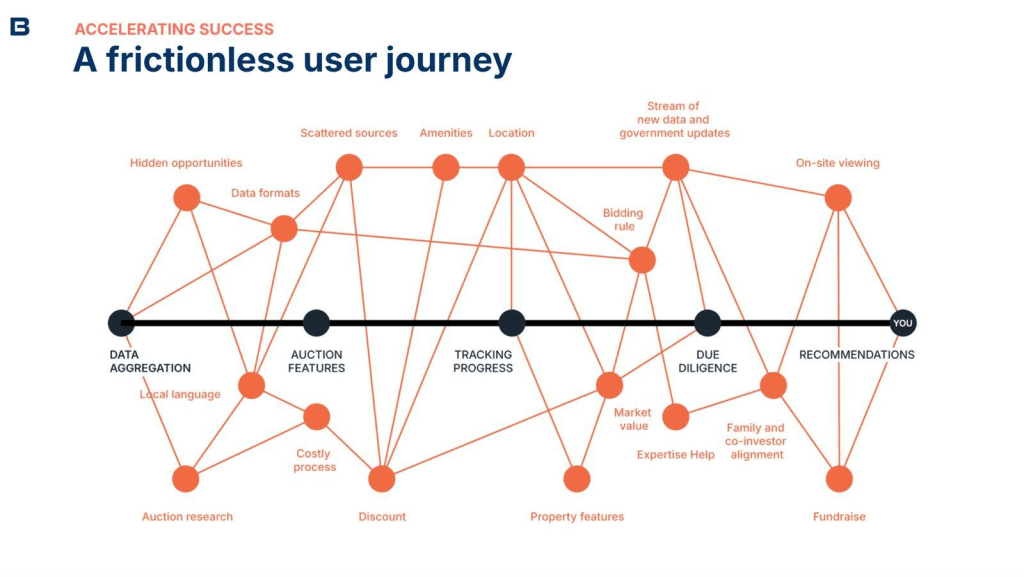
- the platform goes beyond existing PropTech solutions, particularly in cross-border legal and data integration,
- the ambition to apply AI to unstructured legal data was seen as bold and technically non-trivial,
- the underlying architecture and TRL progression were largely credible,
- the intellectual property strategy was well reasoned within European constraints.
In short: the technology vision itself was not the issue.
Where we lost points — and what we took from it
The most important gaps were not about ambition, but about proof.
- Customer demand needed to be demonstrated through real usage and revenue, not intent.
- Market projections needed tighter alignment between ambition and adoption reality.
- Risk mitigation needed to explicitly acknowledge the possibility that the technology itself may fail or underperform.
- Team evaluation went beyond technical excellence into domain empathy and institutional market experience.
One key lesson stood out:
In the EIC Accelerator, inconsistency across criteria stops progress, even when strengths are evident.
What we are doing differently for the next submission
We are actively preparing the next iteration of our Long Proposal, with a clear focus on addressing the feedback.
Specifically, we are:
- bringing real customer traction and usage data to demonstrate demand and willingness to pay,
- strengthening IP protection, including pursuing patent filings where applicable,
- deepening the articulation of radical technological innovation, supported by empirical results and validation,
- tightening execution logic and risk framing to match EIC expectations.
This work is already underway.
Final thoughts
The EIC Accelerator is not designed for one-off attempts. It is designed for companies building genuinely difficult technology in difficult markets — and for those willing to improve under scrutiny.
Our first Long Proposal submission gave us clarity, not closure.
We are using that clarity to come back stronger.
If you are considering the EIC Accelerator, go in with:
- time,
- humility,
- real data,
- and the understanding that this is not just a funding application.
It is a full examination of your company — and, if approached seriously, a valuable one.